
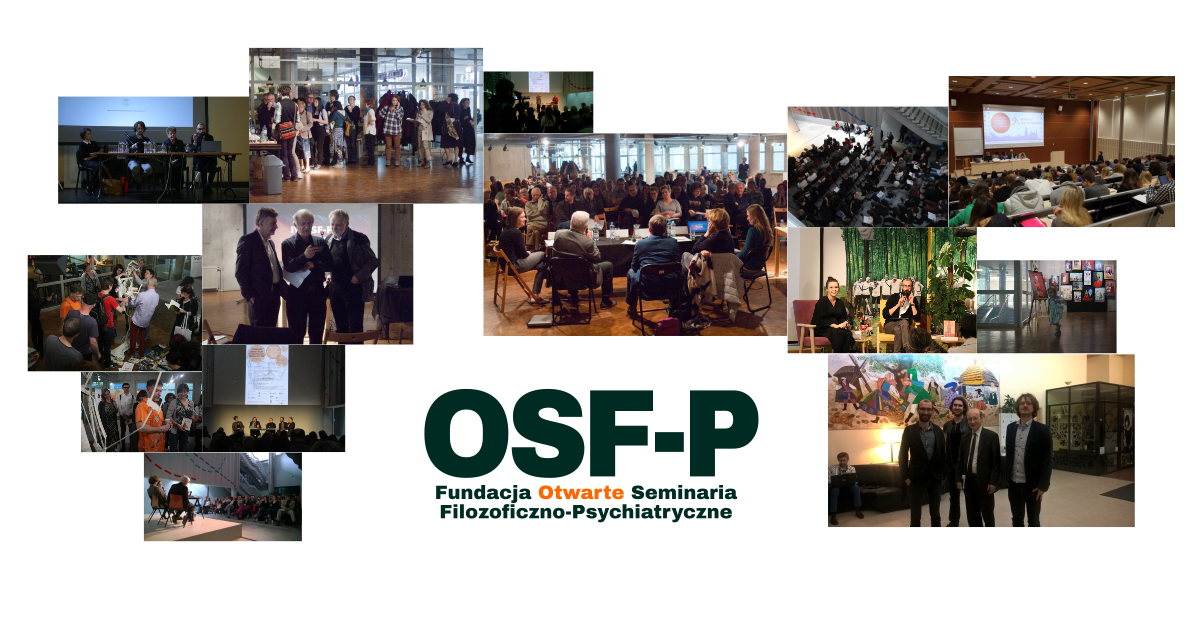
The Open Seminars on Philosophy and Psychiatry Foundation (OSFP) is a Polish non-profit organisation dedicated to promoting recovery-oriented mental health through philosophy, the medical humanities, interdisciplinary dialogue and social inclusion. Although officially registered in 2017, the Foundation has operated since 2015, when it initiated the first Open Seminars on Philosophy and Psychiatry conference. Since then, we have grown from an informal discussion forum into an organisation delivering educational programmes, community initiatives and international cooperation projects.
We believe that mental health is not only a medical issue but also a philosophical, social, cultural and ethical one, requiring cooperation across disciplines and sectors. This conviction shapes our mission: to create spaces where people with lived experience of mental health challenges, mental health professionals, researchers, artists and local communities can learn from one another as equal partners. What began as a series of interdisciplinary conferences bringing together diverse perspectives has gradually evolved into a broad range of educational and community initiatives, with the Masovian Recovery College becoming the Foundation’s flagship programme.
Our core team includes a philosopher, an educator and a peer expert with lived experience. We collaborate with academics, researchers, psychotherapists, psychiatrists, peer support workers, artists and many other professionals working across mental health, education and culture.
We see recovery as a collaborative process built on hope, education, relationships and active participation in community life. Through educational innovation, interdisciplinary cooperation and the meaningful involvement of people with lived experience, we aim to contribute to a more inclusive and recovery-oriented mental health system while building lasting partnerships with organisations across Europe.
The Masovian Recovery College (Mazowiecka Szkoła Zdrowienia) was launched in 2023 as one of the first Recovery Colleges in Poland. Supported through a three-year programme funded by the Masovian Regional Government (2023–2026), it provides more than 100 hours of free educational activities each year, engaging around 70 participants annually. By the end of the programme, approximately 150 individual students will have taken part in its courses and workshops.
The College offers free educational courses and workshops for people with lived experience of mental health challenges, family members and mental health professionals.
The College is based on the principles of co-production. Courses are co-designed and co-delivered by professionals and people with lived experience. Rather than focusing on illness, we understand recovery as each person’s individual journey towards building a meaningful and satisfying life within their community, whether or not symptoms persist. Our educational programmes therefore emphasise hope, personal strengths, meaningful social roles and active participation in community life.
Most courses are delivered in an interactive workshop format. Instead of providing ready-made solutions, they encourage participants to explore their own experiences, identify what matters most to them and develop practical strategies that support their individual recovery and wellbeing.
All courses take place in the welcoming, non-clinical environment of KADR Community Centre, a modern cultural centre in Warsaw. Learning outside healthcare settings helps create an atmosphere of openness, equality and participation, reflecting the Recovery College philosophy that education belongs in the community rather than within clinical services.
The development of the Masovian Recovery College has been informed by ongoing exchanges within the international Recovery College community. During the early stages of the project, colleagues from the Prague Recovery College shared practical experience and educational materials. We also maintain professional links with ImROC (Implementing Recovery through Organisational Change) and participate in the RECOLLECT International Research Consortium (RIRC), coordinated by the Institute of Mental Health at the University of Nottingham. These collaborations help us continuously develop the College in line with international recovery-oriented practice.
The Foundation has been developing a Recovery College model for older adults in cooperation with Universities of the Third Age (UTW). The model was piloted and tested between 2025 and 2026 in cooperation with Universities of the Third Age. It adapts Recovery College principles to later life by bringing together older adults, mental health professionals and people with lived experience. The programme aims to strengthen community mental health support through psychoeducation and mental health literacy, helping older adults recognise and respond to common mental health challenges, including depression, whose symptoms are often masked by physical illnesses in later life.
The project has resulted in two practical open educational resources: a guide on involving Universities of the Third Age in community mental health support networks and a collection of recovery-oriented educational scenarios for working with older adults. Both publications are currently undergoing peer review and are expected to be published under an open licence in autumn 2026.
The project Recovery College for Older Adults was selected as the highest-ranked proposal among 333 submissions to the third edition of the Generator Innowacji. Sieci Wsparcia programme. It is financed by the European Social Fund Plus (ESF+) under the European Funds for Social Development (FERS) programme. The innovation is implemented by PCG Polska (project leader) in partnership with the Towarzystwo Inicjatyw Twórczych „ę”, acting as operators of the innovation incubator.
Between 2022 and 2024, the Foundation implemented the nationwide project The Philosophy of Psychiatry – the Basis of the Mental Health Care System, financed by the Active Citizens Fund – National Programme, supported by Iceland, Liechtenstein and Norway through the EEA Grants.
The project supported the development of recovery-oriented, interdisciplinary and values-based approaches to mental health practice in Poland. During the project, we organised three nationwide online editions of an interdisciplinary course for medical students, involving more than 250 participants from universities across Poland.
A central element of the programme was the introduction of Values-Based Practice (VBP) into Polish mental health education. Developed at the University of Oxford, VBP complements evidence-based practice by supporting collaborative decision-making that takes into account the values and perspectives of all people involved in care. Today, VBP is widely recognised as one of the conceptual foundations of recovery-oriented mental health services, and one chapter of 100 Ways to Support Recovery is devoted specifically to its application. The Polish adaptation of Values-Based Practice was co-developed by a philosopher and a person with lived experience, reflecting the principles of co-production that underpin both VBP and Recovery Colleges.
The project also included a nationwide webinar on philosophy and clinical practice, attended live by more than 250 participants from across Poland. The recording is freely available online with English subtitles, making the educational content accessible to an international audience. We also organised a national interdisciplinary conference bringing together researchers, clinicians and people with lived experience.
Teatr Kryzys was an amateur theatre group for people with lived experience of mental health crises, run by the Open Seminars on Philosophy and Psychiatry Foundation between 2018 and 2025. From 2019 onwards, the group was based at Dom Kultury Stokłosy in Warsaw and worked in cooperation with local cultural institutions, including Dom Kultury KADR.
Instead of treating theatre as a therapeutic intervention, Teatr Kryzys approached artistic creation as a space for collaboration, personal development and public dialogue. Participants worked together over many months to develop performances inspired by literature, philosophy and their own experiences, presenting them to public audiences and engaging in discussions after performances.
Over the years, the ensemble created three original stage productions and a radio play inspired by both classical literature and contemporary philosophical reflection. These included Protest (2018), based on Pavel Kohout’s play; The Shadow-Line (2019), an adaptation of Joseph Conrad’s novel exploring responsibility, maturity and human resilience; Przemiana Salon (2020), a radio drama drawing on Franz Kafka’s The Metamorphosis and The Trial; and Extraordinary (Niesamowite), developed through collective workshops inspired by the stories of Jorge Bucay and the participants’ own reflections on hope, relationships and recovery. Each production was accompanied by public performances and post-show discussions, creating opportunities for dialogue between audiences, artists and people with lived experience of mental health crises.
The initiative was supported by successive grants from the Mazovian Voivodeship and the City of Warsaw, enabling its long-term development as a recovery-oriented cultural programme. In 2024, Teatr Kryzys became part of the educational programme of the Masovian Recovery College.
To mark the group’s fifth anniversary The Foundation published a commemorative album marking the fifth anniversary of Teatr Kryzys album documenting its artistic work, performances and the voices of participants, preserving the project’s legacy and making its experience available to a wider audience. (link)
The Foundation works in close cooperation with universities, cultural institutions, mental health services, local governments and non-governmental organisations. Our long-term academic partner is the Faculty of Philosophy and Sociology at Maria Curie-Skłodowska University (UMCS) in Lublin. Over the years, we have also collaborated with the Institute of Philosophy and Sociology of the Polish Academy of Sciences, the Faculty of Philosophy of the University of Warsaw, the Laboratory of Philosophy of Mental Health at Poznań University of Medical Sciences, Warsaw Fountain House, the eFkropka Foundation, numerous Community Mental Health Centres and other local mental health services, as well as Stokłosy Culture House, KADR Community Centre and the UMCS Chatka Żaka Academic Centre for Culture and Media.
Since 2015, the Foundation has organised, co-organised or partnered in numerous conferences, seminars, public lectures, book launches, panel discussions and educational events devoted to philosophy, psychiatry, psychology and recovery. From its very beginning, we have also supported the Congress of Mental Health (Kongres Zdrowia Psychicznego), a nationwide civic movement advocating for the development of community-based, recovery-oriented mental health care in Poland.
In October 2019, the Foundation organised the 21st Annual Conference of the International Network for Philosophy and Psychiatry (INPP), Experts in Mental Health. The conference brought together participants from 32 countries, creating an international forum for dialogue between philosophers, researchers, clinicians and people with lived experience.
The Foundation takes its name from the Open Seminars on Philosophy and Psychiatry, an interdisciplinary conference series launched in 2015. These conferences brought together philosophers, psychiatrists, psychologists, researchers, artists and people with lived experience to discuss mental health from philosophical, clinical, social and cultural perspectives. Since 2015, the Foundation has organised ten editions of the conference series in Warsaw and Lublin.
Conference editions
2024 – X OSFP – Ritual of Recovery, Faculty of Philosophy, University of Warsaw
2023 – IX OSFP – Education and Values, Faculty of Philosophy, University of Warsaw
2019 – VIII OSFP – Hospital, University of Warsaw Library
2018 – VII OSFP – Antoni Kępiński: Psychiatrist, Human, Philosopher, University of Warsaw
2017 – VI OSFP – Sztuka / theART, University of Warsaw Library
2016 – V OSFP – Anthropology of Experience and Mental Health, Maria Curie-Skłodowska University, Lublin
2016 – IV OSFP – Relations, University of Warsaw Library
2015 – III OSFP – Diagnoses of Modern Times, Maria Curie-Skłodowska University, Lublin
2015 – II OSFP – Norm / Pathology, Museum of Modern Art in Warsaw
2015 – I OSFP – Psychiatry and Philosophy in Search of a Common Language, Museum of Modern Art in Warsaw
Contact
02-797 Warszawa
36 Komisji Edukacji Narodowej Ave, Ofc. 112B
Warsaw, 02-797 Poland
fundacja@osfp.org.p

